Life Sketch
Sri Aurobindo
In 1910 he withdrew from politics and went to Pondicherry in order to devote himself entirely to his inner spiritual life and work.
From 1910 to 1926 Sri Aurobindo continued the practice on yoga and rediscovered the truth in Vedas and Upanishads. Sri Aurobindo presented his great spiritual vision and the path to attain it through the monthly magazine Arya, launched On August l5, 1914, His writings in Arya were later published in the book form. In 1926, with the help of his spiritual collaborator, the Mother, he founded the Sri Aurobindo Ashram.
Sri Aurobindo was an extremely prolific writer. He wrote many books on yoga and spirituality, from his spiritual experiences and vision presenting the evolution of humanity to higher states of Consciousness. His three main magnum opuses are “The Synthesis of Yoga” (1914-21) – giving practical guidance to integral yoga, “The Life Divine” (1914-19) – the description of his spiritual vision and inner experiences , and “Savitri” (1950) – a spiritual epic of about 24,000 verses describing his spiritual journey. Sri Aurobindo’s others work include, The Upanishads, Essays on the Gita (1922), Collected Poems and Plays (1942), The Human Cycle (1949), The Ideal of Human Unity (1949) and Secret of the Veda (1956). Complete work of Sri Aurobindo’s writings is published in thirty-six volumes as Collected Works of Sri Aurobindo, available on Sri Aurobindo Ashram Trust website.
Mother describes “What Sri Aurobindo represents in the world’s history is not a teaching, not even a revelation; it is a decisive action direct from the Supreme.”
In Pondicherry, Sri Aurobindo did intense sadhana to bring down the Truth Consciousness (Supramental Consciousness), to realize the aim of transformation of life on earth.
Sri Aurobindo was a great Visionary, freedom fighter, poet, mystic and a yogi. His thoughts on Education, Nationalism, Integral Yoga and many aspects of human life are inspiring and guiding. Sri Aurobindo left his body on 5 December 1950.
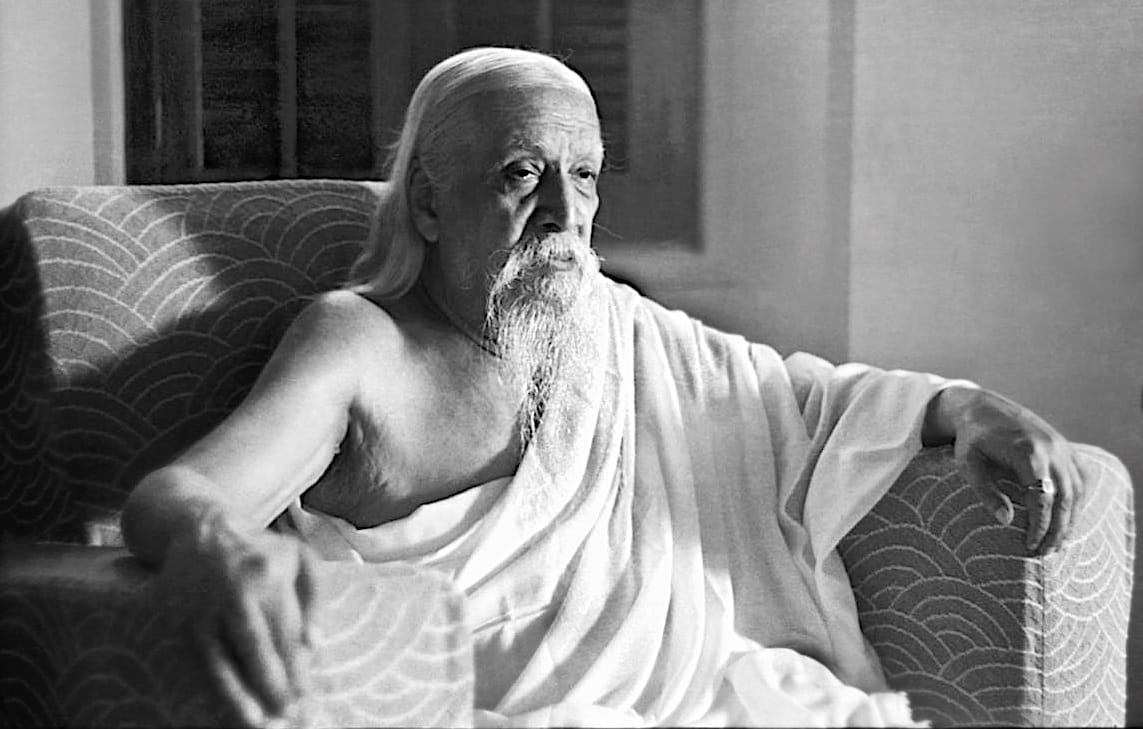
Sri Aurobindo was born in Calcutta on 15 August 1872. At the age of seven he was taken to England for education. There he studied at St. Paul’s School, London, and at King’s College, Cambridge. Returning to India in 1893, he worked for the next thirteen years in the Princely State of Baroda in the service of the Maharaja and as a professor in Baroda College. During this period he also joined a revolutionary society and took a leading role in secret preparations for an uprising against the British Government in India.
In 1906, soon after the Partition of Bengal, Sri Aurobindo quit his post in Baroda and went to Calcutta, where he soon became one of the leaders of the Nationalist movement. He was the first political leader in India to openly put forward, in his newspaper Bande Mataram, the idea of complete independence for the country. Prosecuted twice for sedition and once for conspiracy, he was released each time for lack of evidence.
The Mother
In April 1920 the Mother rejoined Sri Aurobindo in Pondicherry. When the Sri Aurobindo Ashram was formed in November 1926, Sri Aurobindo entrusted its full material and spiritual charge to the Mother. Under her guidance, which continued for nearly fifty years, the Ashram grew into a large, many-faceted spiritual community. In 1952 she established Sri Aurobindo International Centre of Education, and in 1968 an international township, Auroville.
After Sri Aurobindo’s physical withdrawal in 1950, Mother continued the sadhana with him in the subtle domain, to get the Supramental Consciousness, which descended and established on Earth in 1956. After two years of effort, She achieved Nature’s consent to collaborate for transformation. After this, Mother worked on the transformation of physical matter and its building block, the Cell, for fulfilling Sri Aurobindo’s vision.
Mother’s teachings have been published in seventeen volumes as Collected Works of the Mother, available on Sri Aurobindo Ashram website.
The Mother withdrew from the physical world on November 17, 1973.
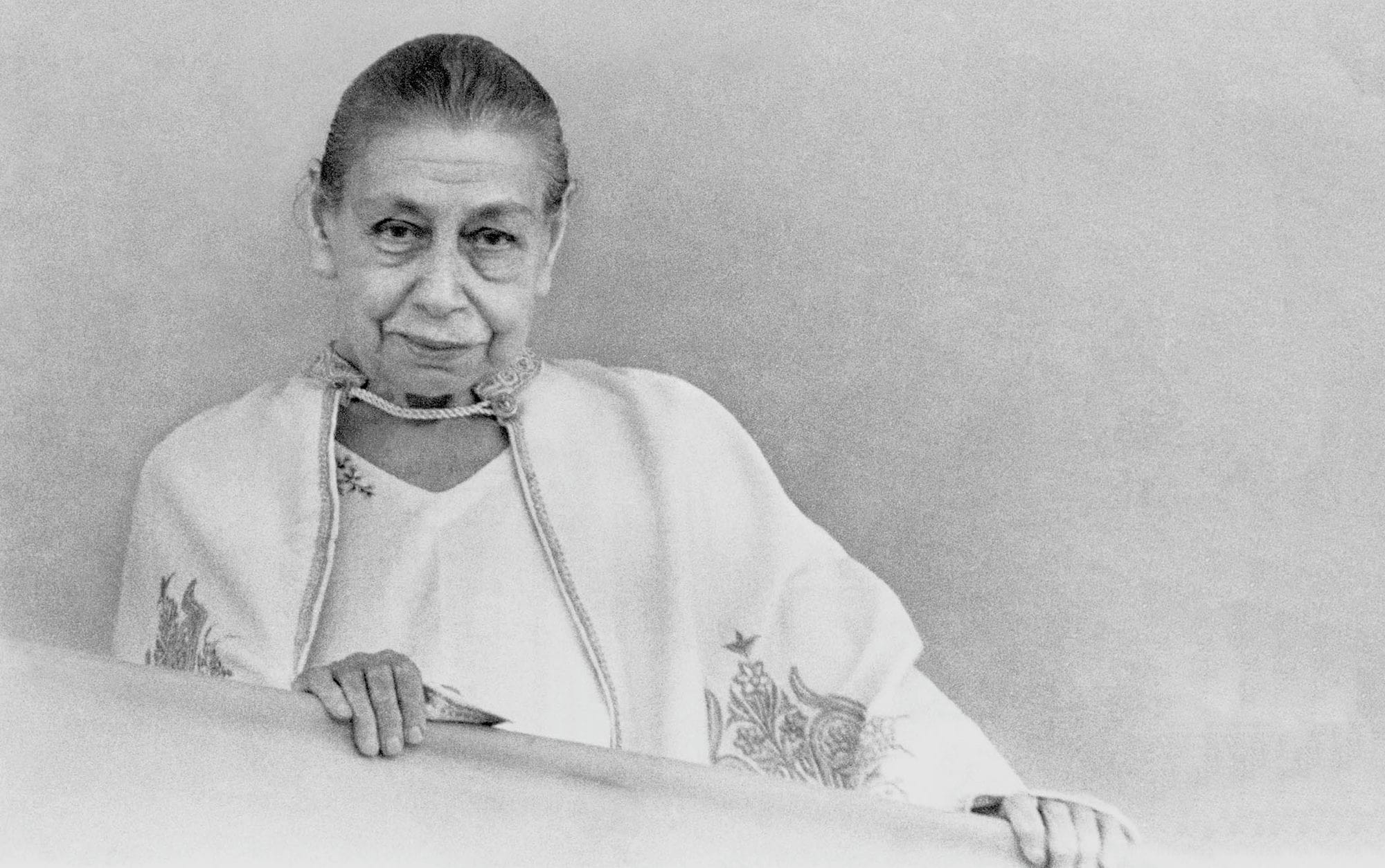
The Mother was born Mirra Alfassa in Paris on 21 February 1878. A pupil at the Academie Julian, she became an accomplished artist, and also excelled as a pianist and writer. Interested in occultism, she visited Tlemcen, Algeria, in 1905 and 1906 to study with the adept Max Theon and his wife. Her primary interest, however, was spiritual development. In Paris she founded a group of spiritual seekers and gave talks to various groups.
In 1914 the Mother voyaged to Pondicherry to meet Sri Aurobindo, whom she at once recognised as the one who for many years had inwardly guided her spiritual development. After a stay of eleven months she was obliged to return to France due to the outbreak of the First World War. A year later she went to Japan for a period of four years